Aegis on The DeFi Drop
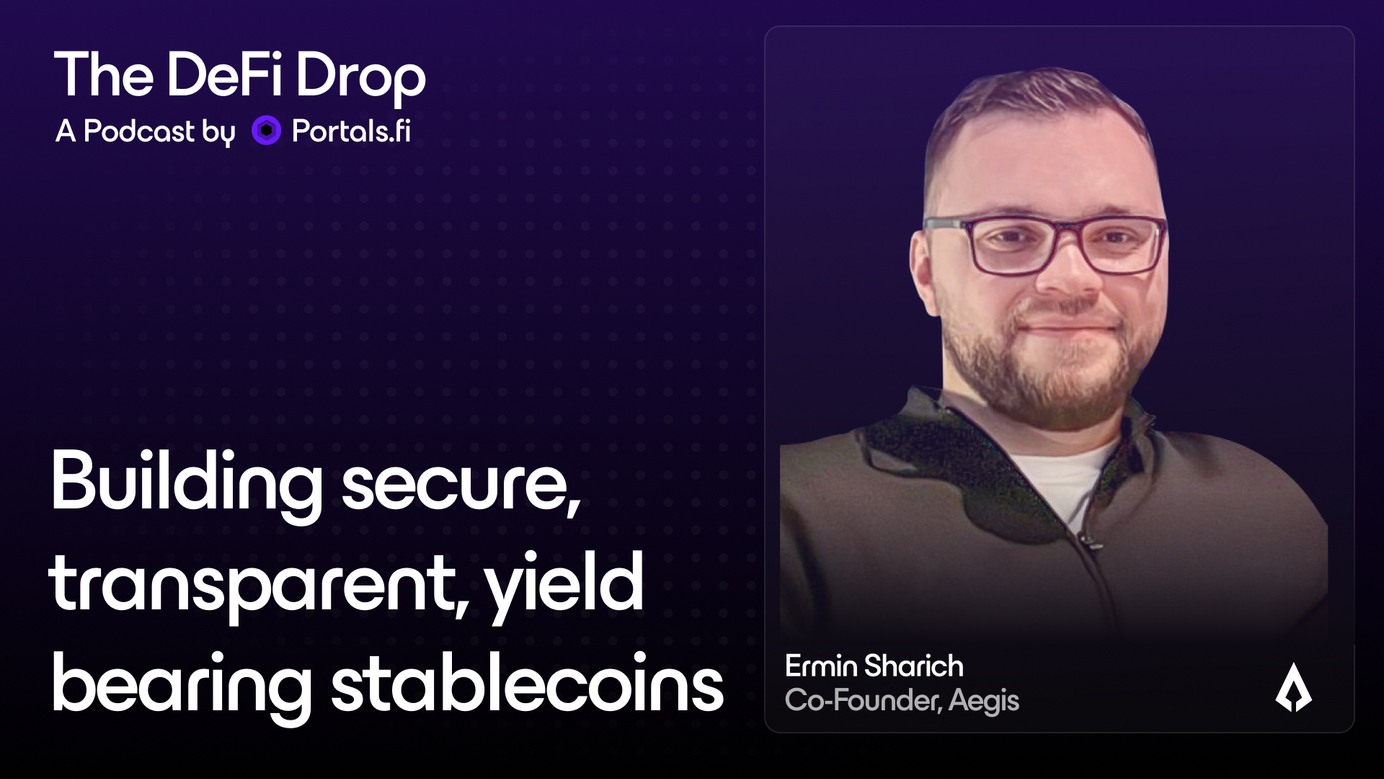
Guest: Ermin Sharich, Co-Founder at Aegis
Host: Edward Ward, Portals.fi
In this episode of DeFi Drop, Edward Ward sits down with Ermin Sharich, co-founder of Aegis, to unpack one of the most important topics in crypto today: how to build secure, transparent, yield-bearing stablecoins that institutions and everyday users can actually trust.
Against a backdrop of banking failures, stablecoin de-pegs, and ongoing macro uncertainty, Aegis is taking a fundamentally different approach, crypto-native, delta-neutral, and built with institutional-grade custody from day one. The conversation dives deep into how Aegis works, how it manages risk, and why stablecoins may be the biggest driver of DeFi growth over the next few years.
The Problem Aegis Is Solving
The collapse of Silicon Valley Bank in 2023 and the temporary de-pegging of USDC that followed, was a wake-up call for the entire crypto industry. For Ermin, it exposed two structural problems with traditional fiat-backed stablecoins:
- Concentration risk in the traditional banking system
- Lack of native yield, despite users holding large cash-like balances
“The USDC de-peg showed that even the most audited, most trusted stablecoin is still exposed to the fiat banking system.” — Ermin
Aegis was created to address both issues by building a crypto-native stablecoin that doesn’t rely on fiat banks and that generates real, sustainable yield.
How YUSD Works: Delta-Neutral by Design
At the heart of Aegis is YUSD, a yield-bearing stablecoin backed by a delta-neutral Bitcoin strategy.
Here’s how it works at a high level:
- Users deposit USDC, USDT, or DAI
- Aegis buys Bitcoin on spot markets
- Simultaneously, it opens an equal short position using BTC perpetual futures
- The long and short positions cancel out price exposure
The result is a price-stable position that earns yield from funding rates paid by leveraged traders.
“We’re not exposed to Bitcoin going up or down. We’re always one-to-one hedged, that’s how we maintain stability.” — Ermin
Crucially, users don’t need to stake or lock up funds to earn yield. Simply holding YUSD accrues returns automatically, creating what Ermin describes as a “Web2-like experience in crypto.”
What Happens When Funding Rates Turn Negative?
Funding rates are positive roughly 87% of the time, meaning shorts earn yield. But what about the other 13%?
Aegis mitigates this risk with a built-in insurance fund:
- 90% of funding revenue goes to users
- 10% is allocated to an insurance reserve
- The reserve is used to support positions during negative funding periods
“We don’t take extra risk to chase yield. The insurance fund exists purely to protect users.” — Ermin
This conservative approach is intentional, and a clear contrast to higher-risk yield products elsewhere in DeFi.
Institutional Custody, Off-Exchange Settlement, and Transparency
Security is a core pillar of Aegis. Instead of keeping collateral on exchanges, Aegis uses institutional custodians like Copper and Fireblocks, combined with off-exchange settlement.
This architecture means:
- Collateral stays in segregated, cold-storage custody
- Positions are traded on exchanges without moving funds
- Counterparty and exchange risk are significantly reduced
- Users can verify reserves in real time
“We never move collateral to the exchange. That extra layer of protection is non-negotiable for us.” — Ermin
In a post-FTX world, this setup is increasingly becoming the standard for serious institutional crypto strategies.
Beyond Savings: Utility Through Aegis DEX
While YUSD’s primary use case is passive yield, Aegis is also building an ecosystem around it.
Through Aegis DEX, users can:
- Use YUSD as trading collateral
- Earn yield while actively trading
- Offset or even eliminate trading fees
“You’re earning on your collateral while trading. That effectively makes trading close to free.” — Ermin
This dual-use design, savings plus utility, gives YUSD an edge over traditional stablecoins that sit idle on exchanges.
Stablecoins as a Solution to Global Currency Instability
The discussion also zooms out to the macro level. In countries facing high inflation or currency collapse, such as Argentina, Turkey, or Nigeria, stablecoins are already acting as a financial lifeline.
Aegis adds another layer: yield on dollar-denominated savings.
“People can protect their savings in dollars and earn yield at the same time. That’s incredibly powerful.” — Ermin
Even in developed markets, Aegis offers an alternative to low-yield TradFi instruments like U.S. Treasuries.
What’s Next for Aegis?
Looking ahead, Aegis plans to expand its stablecoin lineup with additional products targeting different risk profiles.
Key highlights:
- A second stablecoin with higher APY
- Same institutional custody and infrastructure
- Risk segregation between products
- Public reveal planned for early January
“We want users to choose the strategy and risk profile they’re comfortable with, without compromising on capital protection.” — Ermin
DeFi TVL Prediction: The Closing Question
To wrap up the episode, Ermin tackled the show’s recurring prediction question:
- DeFi TVL end of 2025: ~$118B
- DeFi TVL end of 2026: ~$300B
He believes the next wave of growth will be driven largely by stablecoin adoption, reinforcing Aegis’s long-term thesis.
“Next year will also be the year of stablecoins.” — Ermin
Final Thoughts
This episode of DeFi Drop makes one thing clear: as crypto matures, trust, transparency, and risk management matter more than ever. Aegis is betting that the future of stablecoins won’t be built on maximum yield, but on institutional-grade foundations that scale globally.
You can learn more about Aegis at aegis.im, and stay tuned for upcoming integrations and new stablecoin launches.
About Aegis
Aegis is an institutional-grade stablecoin issuer enabling users to earn delta-neutral yield while retaining DeFi composability. Their approach combines BTC-backed collateral with risk-managed hedging strategies to offer predictable, redeemable, and on-chain stable assets. Learn more at aegis.im.
About Portals.fi
Portals.fi is a DeFi meta-aggregator that allows users to swap, zap, and bridge into complex positions across chains. Through the Portals Explorer, users can discover curated vaults, lending markets, and cross-chain strategies in a few clicks. Portals also supports DeFi builders through Cross-Chain Apps powered by intent infrastructure.
App | X | Discord | Telegram | Developers | Support
Portals.fi Blog Newsletter
Join the newsletter to receive the latest updates in your inbox.