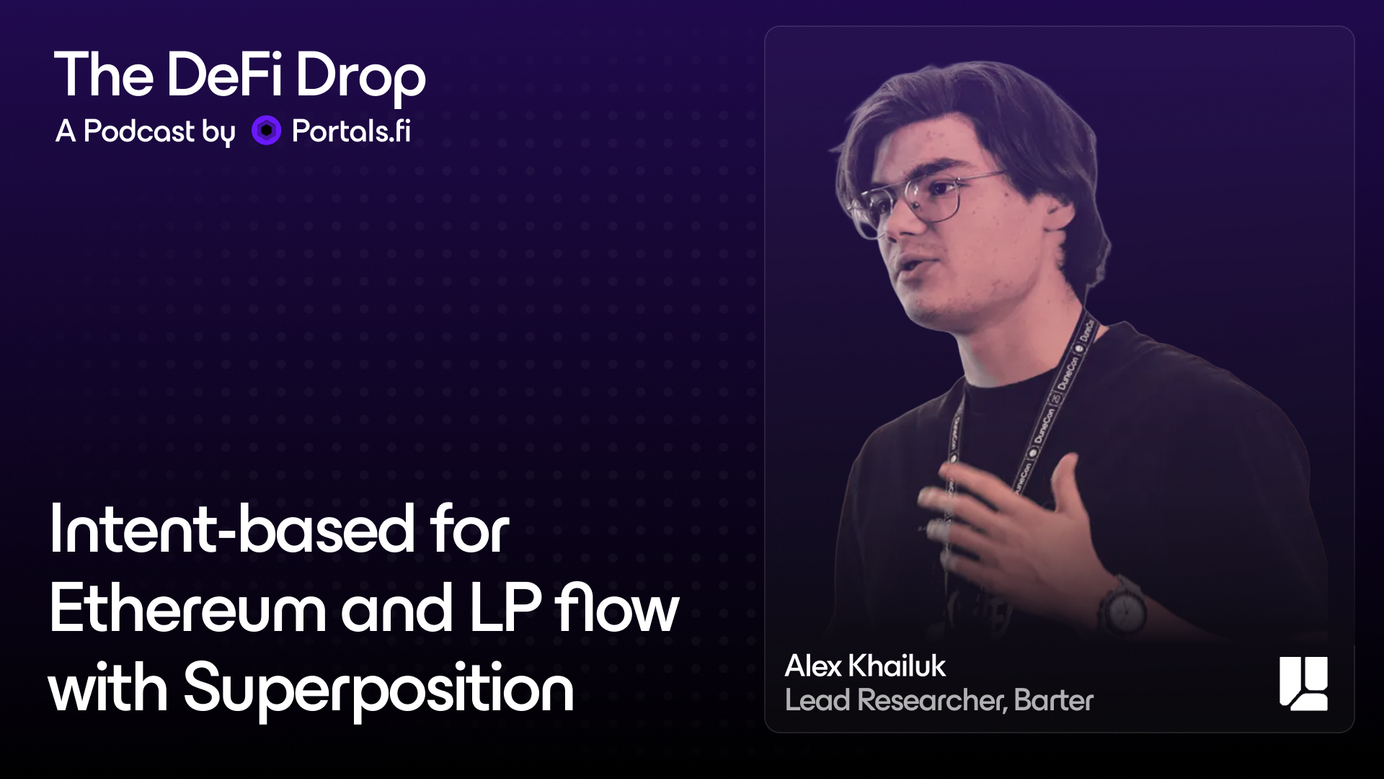
Barter on The DeFi Drop
Guest: Alex Khailuk, Lead Researcher at Barter
Host: Edward Ward, Portals.fi
Inside Ethereum’s Hidden Trading Engine
In this episode of The DeFi Drop, Edward Ward had a chat with Alex Khailuk, lead researcher at Barter, the intent-based trading engine quietly powering a major share of Ethereum’s order flow. With over $33 billion in total volume, more than 500,000 transactions, and connections to 100,000 unique wallets, Barter operates behind the scenes across nearly every major liquidity source on and off chain.
"Swapping is a very important activity in DeFi. We expect swap volumes to grow dramatically because every new asset that comes on chain must be traded," Alex explained.
What Barter Actually Does
Barter is not a typical DEX. It works as a solver within CoW Swap’s intent-based architecture, combining elements of a DEX aggregator, MEV bot, and market maker. When a user submits a trade, Barter competes to deliver the most efficient route by accessing over 40+ liquidity venues, including AMMs, RFQs, aggregators, and advanced pools like Euler-style markets.
"From day zero we were building to scale the system. For a DEX, getting meaningful order flow on day one is critical, so they come to us early. If you can provide good pricing, users do not need to know who you are, they just route through you."
The Hidden Tax of DeFi Trading
Alex described a key friction point in DeFi today: the "hidden tax" of poor routing and MEV. Most users lose value without realizing it, due to fragmented liquidity or poorly placed transactions. Barter helps fix this by aggregating pricing and managing execution placement to reduce value leakage.
"With Barter and CoW Swap you do not need to care about how to land a transaction on chain. You give us the order and minimum price, and we handle the rest so you capture your share of the opportunity."
Tapping Into Private Liquidity and RFQs
Barter plays a crucial role in connecting users with private liquidity — especially RFQ market makers like Wintermute and Symbolic. Around 40% of CoW Swap’s order flow already moves through this underutilized layer, which requires curated access. Barter aggregates this alongside public pools to give users a more complete pricing surface.
Introducing Superposition: Liquidity from Every Wallet
Barter’s latest innovation is Superposition, a liquidity model that allows users to earn yield directly from their wallets. Instead of depositing stablecoins into a smart contract, users approve Superposition to access their funds. When a profitable stable-to-stable trade appears, Barter executes it, returning the funds plus a small yield.
"We remove the deposit and withdrawal step from the classical workflow. All you need to do is approve your USDC or USDT, and when we find a profitable opportunity we execute from your wallet. It is like turning your wallet from a spending account into a savings account."
Better Yield, Smarter Execution
Superposition works more like an RFQ system than an AMM. It avoids adverse selection by only executing trades that are profitable for LPs. Quotes are calculated off chain and executed when they meet preset conditions. This helps deliver stronger outcomes for users, without complexity.
"We are basically doing what professional market makers do, but we abstract away all the complexity. Users get access to sophisticated, fair pricing of their liquidity without tuning any parameters."
Use Cases: Embedded Liquidity and Wallet Integrations
For wallets and front ends, integrating Barter offers deep liquidity access. With Superposition, apps can let users keep their assets on hand, earn passive yield, and still spend them at any time. Alex believes this model aligns well with future stablecoin-based payments.
"Most users do not care about the letters before and after USD. It is all dollars for them. Superposition lets you pay for coffee while those dollars are still earning yield from trading activity."
Balancing Centralization and Future Decentralization
The current Superposition system is centralized by design, allowing Barter to protect LPs from MEV and ensure performance. Long term, the team is focused on making it more trustless and verifiable, with cryptographic proofs and decentralized architecture on the roadmap.
"In the first version we chose centralization to find product market fit. Longer term our main effort is to make Superposition more decentralized and more trustless."
What Comes Next for DeFi Trading
Alex believes the lines between CEX and DEX UX are already blurring. With features like gas abstraction and smart accounts becoming common, the user experience is improving fast. If Barter and Superposition succeed, wallets will feel like yield-bearing payment accounts, and users will interact with DeFi through simple, optimized flows.
DeFi TVL Prediction Game
In the closing segment, Alex predicted a TVL of $110B by the end of 2025 and $150B by the end of 2026. His take balanced increased capital efficiency with expected inflows from RWAs and new digital assets.
"Capital efficiency has increased dramatically. Some applications will need less TVL, but RWAs and new assets will bring a lot of capital on chain. I try to stay objective."
About Barter
Barter provides advanced DeFi trading engine, acting as a leading solver on CoW Swap and a major routing engine on Ethereum. It connects wallets and front ends to public and private liquidity sources, including AMMs, RFQs and its own Superposition liquidity network, with a focus on execution quality and capital efficiency.
About Portals
Portals.fi is the DeFi super app, unifying discovery, trading, yield and automation in a single interface and API. From swaps and zaps to loops and yield strategies, Portals connects users and builders to 20 million plus assets and thousands of protocols across every major chain, making DeFi simple, reliable and powerful.
Portals.fi Blog Newsletter
Join the newsletter to receive the latest updates in your inbox.