Frax on The DeFi Drop
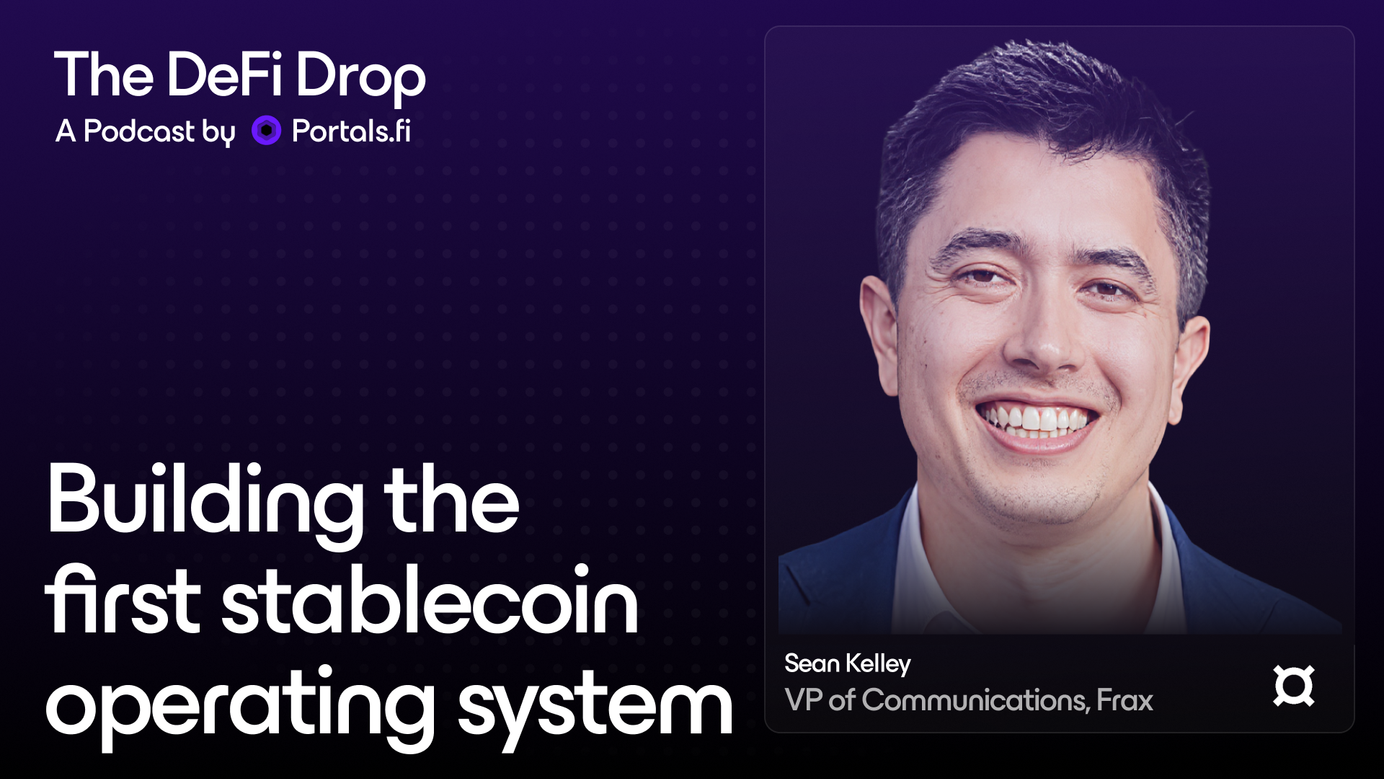
Guest: Sean Kelley, VP of Communications at Frax
Host: Edward Ward, Portals.fi
In this episode of The DeFi Drop, Edward Ward speaks with Sean Kelley, VP of Communications at Frax, about how the protocol has evolved from a stablecoin experiment into a full digital‑dollar infrastructure stack. Frax now operates at the intersection of stablecoins, Layer 2 scaling, real‑world assets, and regulated on‑chain payments.
“Frax is building the first stablecoin operating system,” Sean explained. “A unified stack composed of frxUSD, our GENIUS digital dollar; Fraxtal, the high‑performance chain powering it; and FraxNet, the interface for minting, redeeming and earning against real‑world assets.”
With the launch of Fraxtal, Frax now controls its own EVM‑equivalent execution layer, built for payment‑grade throughput, low fees, and native integration with the Frax ecosystem.
From Algorithmic Stablecoin to Digital‑Dollar Infrastructure
Sean shared how his background in mechanical engineering and IoT led him into DeFi and eventually to Frax. What impressed him early on was Frax’s first‑principles engineering culture and its ability to consistently deliver competitive yields across stablecoin and ETH staking products, including sfrxETH.
That same engineering mindset led Frax to build Fraxtal as a purpose‑built roll‑up rather than spinning up a generic OP Stack chain. Fraxtal uses modular components with its own data availability layer, custom incentive engine, and infrastructure tuned for stablecoin settlement.
“We want complete control over the stack,” Sean said. “When you’re building for a future with trillions in digital dollars, you have to optimise every layer for scale.”
FLOX and Programmable Network Incentives
A central topic in the discussion was FLOX, Fraxtal’s programmable incentive system. FLOX uses a ranking model inspired by PageRank to identify which contracts and accounts create the highest network value. Incentives are then distributed based on actual usage and connectivity rather than static emissions.
“The beauty of FLOX is flexibility,” Sean explained. “It rewards real usage, not just mercenary airdrop farming, and it lets us signal to builders exactly where the network wants to grow.”
This structure allows Frax to guide liquidity and development without relying on subjective grant committees or politicised funding processes.
FXTL, Governance and Long‑Term Alignment
FXTL points, which will later map to Fraxtal’s governance token, are designed as a secondary incentive rather than the primary reason developers build on the network. Frax’s goal is for builders to choose Fraxtal for its liquidity depth, infrastructure quality, and DeFi‑native design.
The token launch has been temporarily postponed due to market conditions, but the long‑term plan remains intact. FXTL will eventually power governance, emissions control, and full ecosystem coordination.
Frax Name Service and the Digital‑Nation Model
Sean outlined Frax Name Service, a simplified identity system inspired by ENS but designed for direct financial integration. Frax usernames function as yield‑earning on‑chain bank accounts that connect directly into FraxNet.
“We think of Frax as a digital nation,” Sean said. “Identity is core to that.”
All FNS activity ties directly back into Frax tokenomics through burns and long‑term emissions offset mechanisms.
Mesh and Secure Cross‑Chain Bridging
Bridging has been one of the hardest UX challenges in DeFi. Frax approached it with security‑first design, starting with FraxFerry and later evolving into Mesh, a unified cross‑chain system built on LayerZero’s OFT standard with Frax operating its own validation instance.
Mesh enables frxUSD, sfrxETH, and the Frax ecosystem to move across more than 20 chains with native issuance and no fragmented liquidity.
“Security, speed and native issuance were our guiding principles,” Sean said. “Mesh gives us all three.”
Fraxtal acts as the hub in this hub‑and‑spoke architecture, allowing efficient L2‑to‑L2 transfers without repeatedly settling back to Ethereum.
Custom Data Availability and Payment‑Grade Scale
Fraxtal also includes a custom modular data‑availability layer, which supports multiple backends including IPFS. This design ensures resilience, redundancy, and adaptability as the data‑availability landscape evolves.
This architecture is built specifically to support payment‑grade throughput and future regulated digital‑dollar settlement.
Builder Opportunities in DeFi, RWAs and Payments
Fraxtal targets builders working in:
- Lending and borrowing protocols
- Stablecoin and payments infrastructure
- Tokenized treasuries and RWAs
- On‑chain settlement systems
“The future of payments is on‑chain,” Sean said. “FraxNet and frxUSD are built to plug into that future as networks start integrating GENIUS digital dollars.”
Fraxtal is not designed as a social chain. It is built as a serious financial stack.
What Comes Next for frxUSD and Fraxtal
Looking ahead six to twelve months, Sean expects significant acceleration in frxUSD TVL, driven by institutional inflows, white‑label stablecoins, and deeper RWA integration.
Planned upgrades include:
- Expanded FLOX incentive mechanics
- Additional DA backends
- L3 experimentation
- Infrastructure for more complex DeFi applications
As frxUSD grows, Fraxtal’s liquidity base compounds, attracting additional builders and further strengthening network effects.
DeFi TVL Prediction Game
With DeFi TVL at US$ 119 billion, Sean shared his expectation for 2025:
“We’re at peak fear right now,” he said. “But if we zoom out, trillions are coming on‑chain, and Frax is building for the next several decades.”
His forecast for December 31st 2025: US$ 150 billion.
About Frax
Frax is a next‑generation stablecoin and digital‑dollar infrastructure ecosystem composed of frxUSD, a GENIUS‑enabled stablecoin, Fraxtal, a high‑throughput EVM network, and FraxNet, a platform for minting, redeeming, and earning against real‑world assets. The Frax ecosystem spans staking, lending, bridging, identity, incentives, and tokenomics across multiple blockchains and is designed to support the migration of trillions in real‑world assets onto on‑chain financial rails.
About Portals.fi
Portals.fi is a DeFi meta-aggregator that allows users to swap, zap, and bridge into complex positions across chains. Through the Portals Explorer, users can discover curated vaults, lending markets, and cross-chain strategies in a few clicks. Portals also supports DeFi builders through Cross-Chain Apps powered by intent infrastructure.
App | X | Discord | Telegram | Developers | Support
Portals.fi Blog Newsletter
Join the newsletter to receive the latest updates in your inbox.