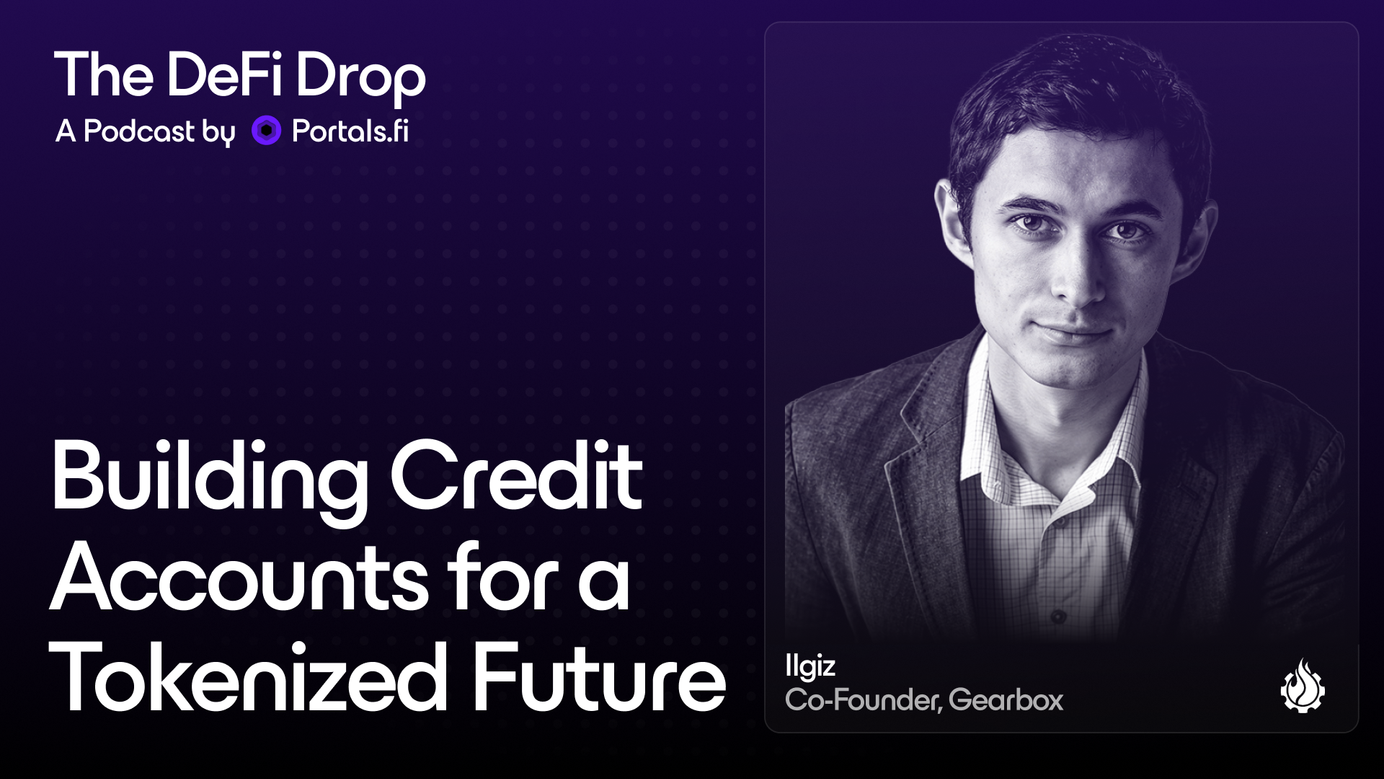
Gearbox on The DeFi Drop: Building Credit Accounts for a Tokenized Future
Guest: Ilgiz (Co-founder, Gearbox)
Host: Edward Ward (Host, The DeFi Drop)
In this episode of The DeFi Drop, Ed sits down with Ilgiz, co-founder of Gearbox, to unpack a deceptively simple idea that unlocks a lot of complexity: a credit account that behaves like a smart wallet, but with borrowed funds inside it. From leverage and structured strategies to tokenized assets with redemption queues and compliance constraints, Gearbox is positioning itself as infrastructure for the next phase of on-chain finance, one where institutions need both composability and control.
Meet Gearbox, and the path to on-chain credit
Gearbox started with a simple idea: make leverage easier to use.
Instead of building another pool-based lending system, the team introduced credit accounts, isolated smart contract wallets that hold both collateral and borrowed funds. What began as a tool for leveraged trading has since expanded into a broader primitive for borrowing, strategy execution, and institutional lending infrastructure.
Ilgiz brings a background in computer science, mathematics, and financial product design, and has been working in crypto since 2016. Gearbox has now been live for over four years without security incidents.
“Credit account is isolated smart contracts that allows to leverage trading on Uniswap… end up with ideas that actually it's new, DeFi primitive for leveraging and borrowing.”
The big idea: a smart wallet with credit built in
If you have used DeFi leverage before, you know the workflow: deposit, borrow, loop, repeat.
Gearbox replaces that with a single structure.
You deposit collateral into a credit account.
You borrow within that same account.
You interact with DeFi protocols using the combined balance.
After each action, Gearbox checks that the position remains over-collateralized.
The result is a wallet that behaves more like a margin account, but fully on-chain and enforced at the protocol level.
“Imagine that your smart wallet have not only your funds, but also some borrowed funds, and you'll be able to interact with all DeFi protocols that exist here.”
Where this changes how DeFi strategies are built
Two practical unlocks show up immediately.
First, execution becomes simpler. Opening and closing leveraged positions no longer requires manual looping or multiple transactions. The interaction model is reduced to a single account that manages both capital and debt.
Second, strategies are no longer constrained by token formats. In pooled systems, positions often need to be represented as ERC-20 tokens. Credit accounts can hold positions directly in contracts, which allows for more complex and less standardized strategies.
This becomes especially important as DeFi moves toward tokenized real-world assets and structured products.
Tokenized assets and the problem of redemption
Tokenized assets bring a different set of constraints.
Minting and redemption often happen through issuer contracts. Withdrawals may involve queues. Compliance rules may restrict access. These flows do not fit cleanly into systems that depend on instant liquidity and standardized collateral.
Gearbox handles this by interacting directly with tokenization platforms from inside the credit account.
A typical flow looks like this:
A user deposits 10k USDC as collateral.
They borrow 90k USDC.
The credit account now holds 100k USDC.
Funds are deposited into a tokenized vault and LP tokens are received.
To exit, the user initiates withdrawal with the issuer. If there is a redemption queue, the position remains tracked during the waiting period. Once completed, funds return to the credit account, debt is repaid, and remaining value is withdrawn.
“You can do it in one hop, indirect interactions with tokenization platforms.”
This removes reliance on DEX liquidity and allows strategies to function even when exits are delayed or non-instant.
Phantom tokens: representing value that is not yet liquid
To support these flows, Gearbox introduces phantom tokens.
These represent value that is locked in a redemption queue or pending withdrawal. They are onboarded by curators and assigned risk parameters so that the system can continue to evaluate collateral during the waiting period.
“Phantom tokens is something that sits inside this withdrawal queue representation.”
This allows Gearbox to treat queued assets as part of the position without requiring immediate liquidity.
Compliance at the account level
Gearbox does not attempt to replicate issuer compliance logic.
Instead, tokenization platforms enforce requirements such as KYC and whitelisting, while Gearbox enables interaction at the credit account level.
Because each account is isolated, enforcement can be applied per user rather than across pooled liquidity. This avoids one of the main operational constraints of shared lending pools.
“Main problem for pool-based lending is actually that funds are mixing up… In case of isolation with credit accounts, you can do a lot of similar logic.”
No-code markets and configurable credit infrastructure
Gearbox is moving toward a model where markets can be launched through configuration.
Curators define:
- Supported collateral
- Risk parameters and LTVs
- Exposure limits
- Monitoring and liquidation rules
They do not custody funds or actively manage allocations. Their role is to define risk frameworks that the system enforces.
“There is no need to do active asset management… all you do is set up risk parameters.”
This opens the door for institutions, asset issuers, and fintech platforms to deploy lending markets without writing smart contracts.
Security: using Ethereum as a source of truth for code
One of the more distinctive parts of Gearbox’s design is its approach to deployments.
Contracts are deployed and referenced on-chain. Auditors verify that the bytecode matches what was audited. Approvals are recorded on-chain, and only after sufficient verification does the code become usable in markets.
“It uses Ethereum as GitHub or storage for code base.”
This model reduces the risk of mismatches between audited and deployed code and limits exposure to supply chain attacks.
Closing game: DeFi TVL outlook
At the time of recording, DeFi TVL is around 105B.
Ilgiz’s prediction:
“200… I remember when DeFi TVL was kind of 600 mil… now it's 100x more.”
About Gearbox
Gearbox provides on-chain credit infrastructure through credit accounts, isolated smart contract wallets that combine collateral and borrowed funds in a single execution layer. Enabling users, curators, and institutions to access leverage, execute strategies across DeFi protocols, and interact with tokenized assets, including those with redemption queues, while maintaining non-custodial guarantees and account-level risk control.
About Portals.fi
Portals.fi is the DeFi Super App, a one-click gateway to the entire on-chain economy. Powered by real-time data and seamless execution, Portals.fi connects traders to over 20 million assets, thousands of protocols, and every major blockchain.
Portals.fi Blog Newsletter
Join the newsletter to receive the latest updates in your inbox.