Lagoon Finance on The DeFi Drop: Building Infrastructure for On-Chain Asset Management
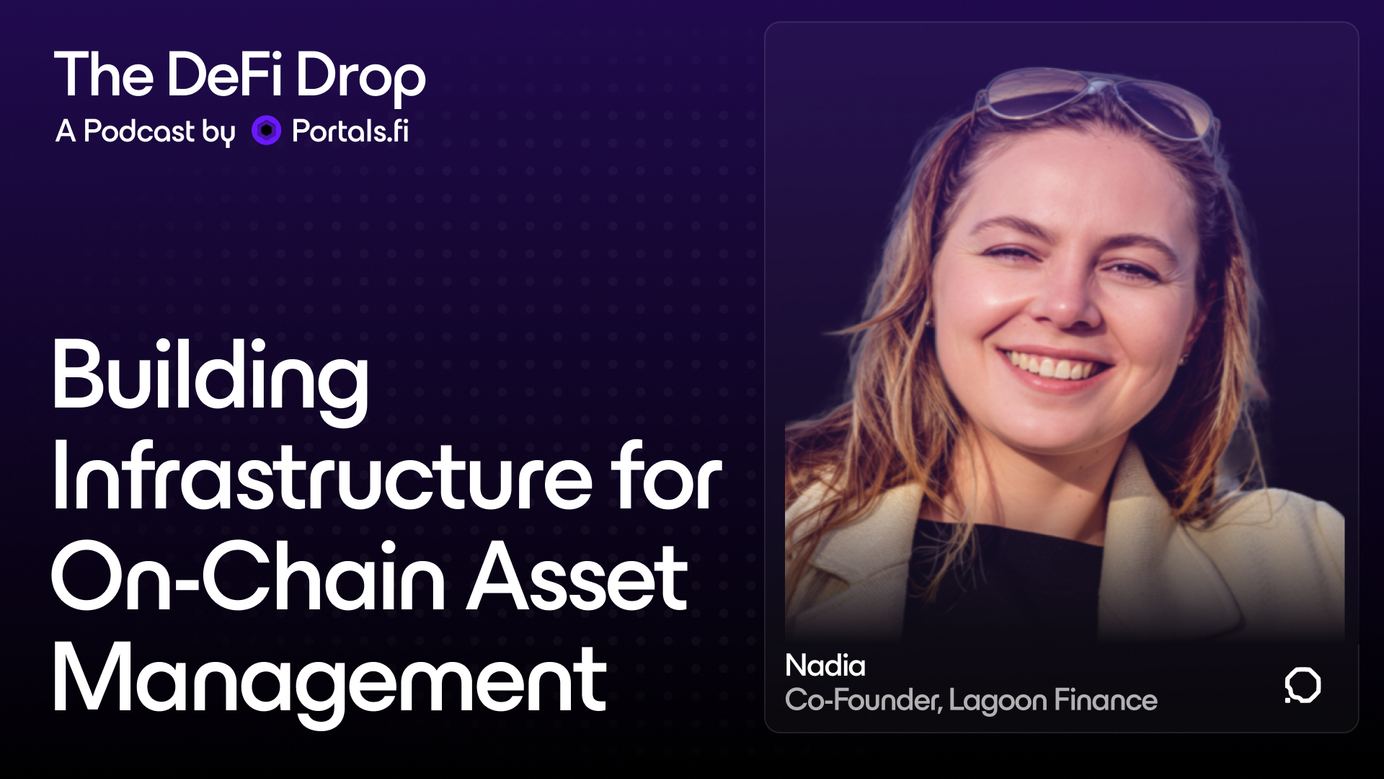
Guest: Nadia, Co-founder, Lagoon Finance
Host: Edward Ward, Portals.fi
How Lagoon Finance Is Building Infrastructure for On-Chain Asset Management
In this episode of The DeFi Drop, Edward Ward speaks with Nadia, co-founder of Lagoon Finance, about the infrastructure needed to support on-chain asset management at scale.
Lagoon Finance has grown rapidly since launch. The protocol currently supports:
- Over $100 million in total value locked (TVL)
- More than 70 active vaults
- Deployments across 18 blockchain networks
- Over 14,000 unique user addresses
The discussion explores Lagoon’s founding story, the technical architecture behind its vault framework, and how tokenised fund administration may reshape capital markets.
The central theme is clear. Asset management infrastructure is moving on-chain, and new tooling is required to support fund managers, curators, and institutional allocators.
From Traditional Finance Lawyer to DeFi Founder
Nadia’s path to founding Lagoon Finance began long before the protocol existed.
After training as a lawyer, she first encountered smart contracts in 2015. At the time, the technology was still niche, but the implications for financial infrastructure were clear.
She later spent several years working in traditional asset management in the City of London, including roles across hedge funds and large asset managers. Her experience expanded into venture capital and deep-tech investments.
By 2022 she was building directly in DeFi, developing a revolving line of credit protocol using smart contracts.
Through that experience she identified a core inefficiency in traditional asset management.
Settlement cycles such as T+5, T+3, and T+2 remain standard in financial markets. These processes create operational overhead and capital inefficiencies that programmable infrastructure can significantly improve.
When Nadia met her co-founder Remi, a computer scientist and long-time DeFi builder, in Bogotá, the idea for Lagoon Finance took shape.
Why Lagoon Uses ERC-7540
Lagoon Finance is built on ERC-7540, a tokenized vault standard that extends the widely used ERC-4626 framework.
The key innovation is asynchronous deposits and redemptions.
Many DeFi vaults assume deposits and withdrawals occur instantly. That model works for certain strategies but not for all forms of asset management.
ERC-7540 introduces a subscription and redemption queue that allows curators to process flows at controlled intervals.
This mirrors traditional fund operations. Investors subscribe to a fund and receive shares after the next net asset value calculation. The process ensures:
- Accurate pricing per share
- Controlled portfolio rebalancing
- Fair treatment of all participants
Lagoon’s architecture includes several key components:
- Safe wallets for asset custody
- Zodiac role modules for permission management
- Automated or manual queue processing by curators
Several protocol rules ensure fair operation:
- Curators decide when to process subscriptions and redemptions
- Both sides of the queue must be processed together
- Subscriptions and redemptions can be netted to reduce gas costs
These mechanics allow strategies to operate in a structured environment while preserving transparency for depositors.
Custody-Agnostic Vault Architecture
A major differentiator for Lagoon Finance is its custody-agnostic design.
Most vault infrastructure platforms impose a specific custody model. Lagoon takes a different approach. The vault contract manages flows, roles, and fees, while the assets themselves can reside in any custody system chosen by the curator.
This flexibility is particularly important for institutional users.
A hedge fund, syndicates, or family office adopting Lagoon can integrate its existing regulated custody provider while still benefiting from on-chain fund administration.
Nadia explains that the protocol was designed by curators who understand the operational requirements of asset managers. Custody remains one of the most important decisions for institutional investors.
Many investment strategies also involve elements that cannot be fully automated through smart contracts. Off-chain agreements, custom deal structures, and regulatory requirements often play a role.
Institutions entering digital assets already operate under strict custody frameworks. Lagoon enables them to bring those frameworks on-chain while retaining transparency.
What Strategies Are Gaining Adoption
Early DeFi vaults were dominated by market-neutral strategies such as lending loops and liquidity provision.
That segment has matured. Major strategy providers including Gauntlet, Steakhouse, and Re7 now manage a significant portion of this activity.
Lagoon is seeing increased demand for more diverse strategy categories:
- Structured yield products
- Private credit strategies
- Directional trading strategies
- Algorithmic portfolio strategies
- Hybrid strategies combining on-chain and off-chain execution
Future differentiation among asset managers will likely come from the ability to source unique opportunities and build proprietary investment processes.
Lagoon positions itself as the infrastructure layer that allows those strategies to operate efficiently on-chain.
Tokenisation of Capital Markets
The tokenisation of financial assets continues to attract attention from regulators and industry participants.
The World Economic Forum estimates that tokenising capital markets could reduce operational costs by $15 to $20 billion annually.
Asset management firms face significant pressure to reduce operational overhead. Fund administration tasks such as subscription processing, NAV calculations, compliance reporting, and fee accounting remain costly and time-intensive.
Lagoon’s architecture moves many of these processes directly into programmable infrastructure.
Launching a fund traditionally requires multiple service providers and months of setup. Lagoon enables similar structures through smart contracts that manage:
- Investor flows
- Fee structures
- Governance roles
- Reporting and administrative functions
Regulatory developments also support this direction.
The UK Financial Conduct Authority’s CP25/28 consultation, published in October 2024, outlines a framework for tokenised fund registers and direct-to-fund dealing models. Similar developments are underway in Singapore under the Monetary Authority of Singapore.
These regulatory signals suggest that tokenised fund administration may become a core component of future financial infrastructure.
Lagoon’s Roadmap: Full-Cycle Fund Administration
Lagoon launched with core components that support tokenised flows, fee management, and governance roles.
The roadmap extends toward full-cycle fund administration.
The goal is to support the complete lifecycle of pooled investment vehicles including:
- Venture capital funds
- Hedge funds
- DAO investment vehicles
- Family offices
- On-chain strategy curators
Automation tools are also under exploration, including AI-assisted workflows.
Nadia approaches AI cautiously. Automation can improve compliance processes, reporting, and operational efficiency. The most practical model is human-in-the-loop systems where automation supports decision making rather than replacing it.
Historically, many financial institutions addressed operational complexity by adding more staff. Technological infrastructure changes that equation.
Quality Control on a Permissionless Platform
Lagoon operates as a permissionless protocol where anyone can deploy a vault.
However, only vetted vaults appear on the protocol’s main interface.
New vaults receive a direct link that allows access without public listing. The Lagoon team evaluates curators and monitors vault performance before listing them on the front page.
Several protections are enforced at the protocol level:
- Curator wallet and NAV wallet addresses are publicly visible
- All vault roles are transparent and cannot be modified by the curator
- High water marks are enforced for fee calculations
- Fee changes include a mandatory cooldown period
These guardrails provide transparency while preserving permissionless deployment.
Nadia also emphasizes a fundamental investment principle. Yield always reflects risk. Higher returns typically correspond to higher risk exposure.
Users still need to evaluate the curator, strategy design, and risk profile before allocating capital.
Infrastructure can improve transparency, but investment decisions remain the responsibility of the investor.
DeFi TVL Outlook
At the time of recording, total value locked across DeFi protocols was approximately $92 billion.
Nadia’s forecast for June 21, 2026 is $120 billion to $125 billion.
The expectation is steady expansion rather than rapid spikes in activity.
As Nadia summarized during the conversation:
“slow and steady wins the race.”
About Lagoon Finance
Lagoon Finance is the infrastructure for on-chain asset management. It provides curators, risk managers, hedge funds, funds and syndicates with a permissionless vault framework built on ERC-7540, enabling flexible fund administration, custody-agnostic deployment, and full-lifecycle flow management across 18+ chains.
About Portals.fi
Portals.fi is the DeFi Super App, a one-click gateway to the entire on-chain economy. Powered by real-time data and seamless execution, Portals.fi connects traders to over 20 million assets, thousands of protocols, and every major blockchain.
Portals.fi Blog Newsletter
Join the newsletter to receive the latest updates in your inbox.