

Portals DeFi Weekly - 6th February, 2026
Welcome to the Portals DeFi Weekly, your weekly dose of the latest insights and analysis in DeFi.
Market Pulse
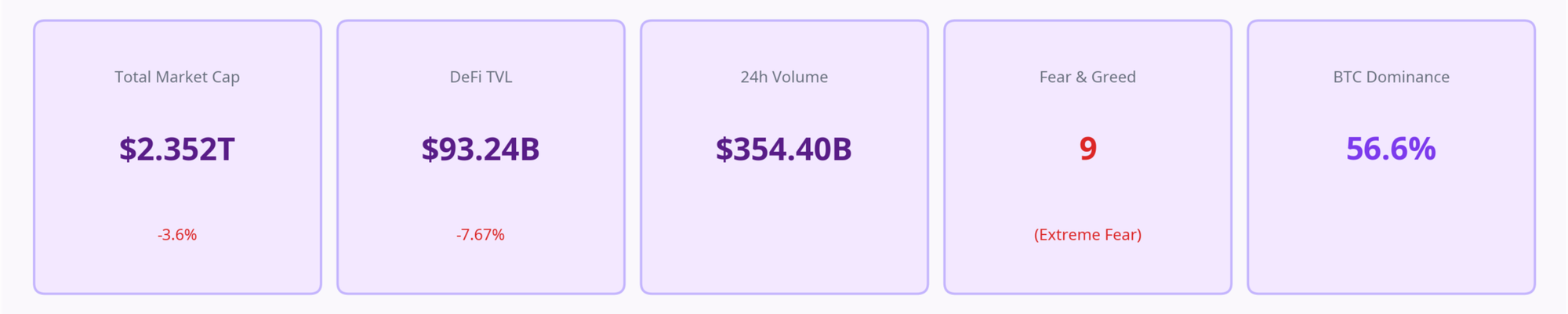
- Total Market Cap: $2.352T (-3.6%)
- DeFi TVL: $93.24B (-7.67%)
- 24h Volume: $354.40B
- Fear & Greed: 9 (Extreme Fear)
- BTC Dominance: 56.6%
Summary

The market is in the grip of its most severe correction since the 2022 bear market. The total market cap has plunged to $2.352 trillion, down 3.6% in the past 24 hours alone, while DeFi TVL has cratered to $93.24 billion, a staggering 7.67% daily decline that has erased weeks of accumulated value. The Fear & Greed Index has collapsed to 9, Extreme Fear, a reading not seen since the depths of the FTX crisis, down from 16 last week and 42 just a month ago. Bitcoin is trading at approximately $66,574, down 19.4% on the week, while Ethereum has been hit even harder at $1,926, losing 29.6% in seven days.
This week's devastation was triggered by a cascade of converging macro shocks. On January 30, President Trump nominated Kevin Warsh, a known inflation hawk and former Fed governor, to replace Jerome Powell as Federal Reserve Chair. The nomination sent an immediate chill through risk assets, as markets interpreted it as a signal that monetary policy would remain restrictive for longer. Bitcoin dropped from $82,000 to the $75,000-$79,000 range within days, and the sell-off only accelerated from there.
The situation was compounded by escalating tariff threats against multiple nations, including renewed military posturing over Greenland, which pushed gold to new all-time highs above $4,700/oz while risk assets hemorrhaged capital. The Fed's decision to hold rates steady at its latest meeting, combined with hawkish commentary suggesting no cuts before the leadership transition, eliminated any hope of near-term monetary relief.
The resulting liquidation cascade has been historic. Over the past 24 hours alone, $2.65 billion in positions were liquidated, with 586,053 traders wiped out. Long positions accounted for over $2.2 billion of the total. This follows a $2.56 billion liquidation event on January 31, both ranking among the top 10 largest crypto liquidation events of all time. Bitcoin market depth has collapsed to just 30% of its October peak, mirroring conditions last seen after the FTX collapse.
ETF outflows have been relentless. On February 2, BlackRock's IBIT alone saw $528 million in outflows in a single day. Net outflows reached $512 million in the latest 24-hour period, with cumulative January-February outflows representing a 6.6% decline in total BTC held by ETFs. Institutions are actively de-risking rather than buying the dip.
According to analysts, Bitcoin could fall as low as $38,000 based on historical drawdown patterns, a potential 70% decline from the October all-time high of $126,000. This is taking into consideration that Bitcoin has decoupled from both the weakening dollar and rising global liquidity, undermining its narrative as a fiat hedge. However, these are speculations.
Despite the carnage, there are early signs of potential capitulation. Glassnode's capitulation index recorded its second-largest spike in two years, a metric that historically signals local bottoms. The massive deleveraging is clearing overleveraged positions, and DEX volumes have surged 43.19% weekly to $108.4 billion, indicating active repositioning rather than complete capitulation. Economist Daniel Lacalle noted that "Bitcoin deleveraging may create a strong opportunity soon." Ethereum gas fees remain at a remarkably low 0.348 Gwei, providing an exceptionally cheap environment for on-chain activity during what may prove to be a generational buying opportunity or the beginning of a deeper bear market.
The Yield Market Pulse
The yield landscape has shifted dramatically this week as the market crash reshapes DeFi lending dynamics. Contrary to what many might expect during extreme volatility, stablecoin lending rates have actually compressed rather than spiked. Aave Ethereum USDC yields have fallen to 2.94% APY (down from 4.35% last week) as the massive deleveraging event has reduced borrowing demand, prompting traders to close positions and repay loans rather than open new ones. This marks a notable departure from the January 30 correction, when rates initially rose before the sell-off deepened.
The compression in variable lending rates has made fixed-yield strategies via Pendle particularly attractive. Pendle's PT-sUSDe market is offering a 4.67% fixed APY with $870.95M in TVL, a premium of over 170 basis points above Aave's variable rate. Pendle's Boros platform also hit a $10 billion notional volume milestone this week, demonstrating the growing appetite for yield trading infrastructure even during market turmoil. Meanwhile, Maple's Syrup USDC continues to lead the stablecoin yield market at 5.09% APY with $2.56B in TVL, benefiting from its institutional-grade borrower base that maintains demand regardless of market conditions.
Top Opportunities This Week
We have identified the following top-tier, sustainable yield opportunities for this week, from Portals:
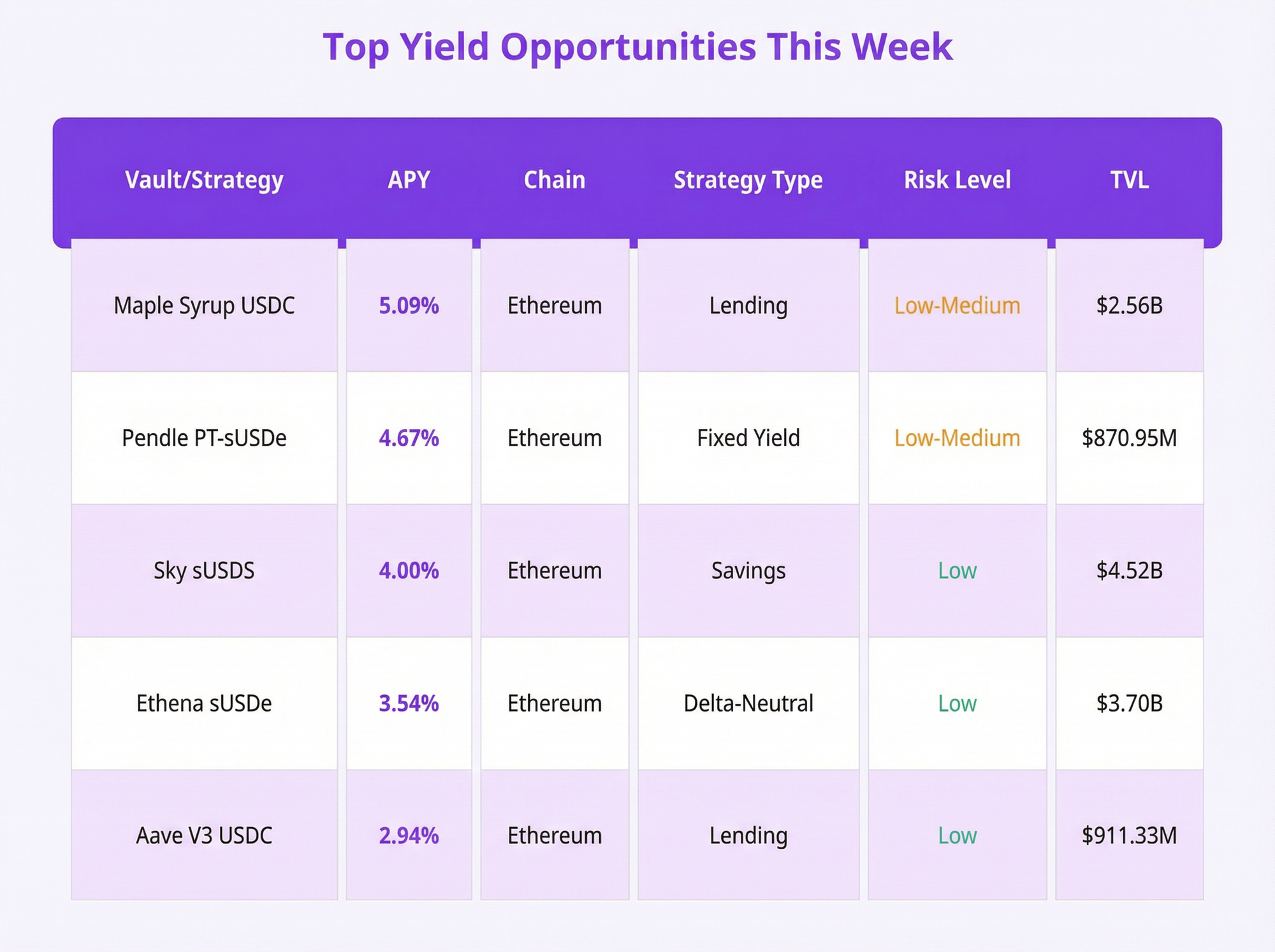
Maple Syrup USDC: The institutional-grade lending protocol continues to deliver the highest sustainable stablecoin yield at 5.09% APY with $2.56B in TVL. Maple's overcollateralized loan pools backed by vetted institutional borrowers provide consistent returns that have remained remarkably stable through the crash, declining only marginally from 5.22% (30d average).
Pendle PT-sUSDe: This week's standout opportunity. By purchasing the Principal Token on Pendle, users can lock in a 4.67% fixed APY on Ethena's sUSDe for 61 days — effectively hedging against further yield compression. With $870.95M in TVL across Pendle's sUSDe markets, this represents one of the most capital-efficient ways to secure predictable returns during uncertainty.
Sky sUSDS: The savings rate vault from Sky (formerly MakerDAO) holds steady at 4.00% APY with an impressive $4.52B in TVL. As one of DeFi's most battle-tested stablecoin savings products, sUSDS has maintained its rate through multiple market cycles, making it the go-to option for risk-averse capital.
Ethena sUSDe: Ethena's delta-neutral vault has seen its yield compress from 4.69% (30d average) to 3.54% current, reflecting the collapse in perpetual futures funding rates as leveraged longs were liquidated. Despite the yield decline, the protocol's $7.26B total TVL and $3.70B in sUSDe deposits demonstrate continued confidence in its mechanism.
Aave V3 USDC: The gold standard for decentralized lending has seen its yield drop significantly from 4.35% to 2.94% as borrowing demand evaporated during the deleveraging event. While the current rate is less attractive, Aave's $911.33M USDC pool remains the most liquid and battle-tested lending option in DeFi.
Yield Tip of the Week
"When variable rates compress, lock in fixed yields." This week's crash has created a rare divergence: Pendle's fixed PT-sUSDe yield (4.67%) now trades at a significant premium to Aave's variable USDC rate (2.94%). During deleveraging events, variable lending rates can remain depressed for weeks as borrowing demand stays low.
DeFi News
This week's DeFi news cycle has been dominated by the market crash, but beneath the surface, landmark regulatory developments, critical security incidents, and significant protocol upgrades are reshaping the landscape in ways that will outlast the current volatility.
SEC and CFTC Launch Unified "Project Crypto"
In what may prove to be the most consequential regulatory development of 2026, the SEC and CFTC jointly announced "Project Crypto" on January 29, transforming what had been an internal SEC initiative into an inter-agency collaboration. The joint framework directly addresses two longstanding problems that have plagued the digital asset industry: the persistent uncertainty about which agency has jurisdiction over particular products, and the potential for turf battles between regulators that have left market participants caught in the crossfire.
DeFi's Quiet Strength: TVL Holds as Market Crashes
Despite Bitcoin and Ethereum plunging to multi-year lows, DeFi's total value locked has proven surprisingly resilient. TVL fell from $120 billion to $105 billion, a 12% decline that significantly outperformed the broader market's 25-30% drawdown. More tellingly, the amount of ETH deployed across DeFi protocols actually increased from 22.6 million to 25.3 million ETH, with 1.6 million ETH added in the last week alone.
The DeFi market is also far better collateralized than in previous cycles. Only $53 million in positions are liquidatable within 20% of current prices, compared to the $340 million danger zone that existed during the February 2025 correction.
Ethereum's Existential Reckoning: Leadership Crisis and L2 Pivot
Ethereum is facing its most significant internal crisis since the DAO hack. A Guardian investigation published February 5 revealed deep divisions within the Ethereum Foundation following a leaked pitch from developer Danny Ryan to reshape the organization's leadership. The controversy exposed tensions between Ethereum's traditional cypherpunk ideology and a more pragmatic faction focused on institutional adoption and ETH's stagnant price, which remains unchanged from November 2024 levels.
Hyperliquid Unveils HIP-4 Prediction Markets
Hyperliquid continues its rapid expansion beyond perpetual futures with the announcement of HIP-4, a protocol upgrade introducing outcome-based trading (prediction markets) on HyperCore.
Separately, Ripple Prime integrated Hyperliquid support, allowing institutional clients to access on-chain derivatives liquidity with cross-margining capabilities.
Lido V3 Goes Live with stVaults
Lido's highly anticipated V3 upgrade launched on Ethereum mainnet, introducing stVaults, modular staking infrastructure that allows Layer 2 networks and institutions to create their own customized Ethereum staking rules.
The upgrade represents a fundamental shift in how Ethereum staking is structured, moving from a one-size-fits-all model to a programmable, institutional-grade framework.
Security & Exploits
January 2026 was a costly month for DeFi security. According to blockchain security firm Halborn, seven protocols suffered hacks totaling approximately $86 million, while a separate social engineering attack on a Trezor hardware wallet user resulted in a staggering $282 million loss, the most expensive DeFi social engineering attack on record.
The most significant protocol exploits included Step Finance ($30-40 million, compromised executive devices on Solana), Trubit ($26.4 million, old contract vulnerability), SwapNet ($13.4 million, smart contract flaw), and SagaEVM ($7 million, supply chain hack).
The RWA Tokenization Narrative Continues To Gain Momentum
With industry leaders declaring 2026 as the year tokenization moves "from experimental pilots to active global markets." New cryptocurrency tax rules are also taking effect in 2026, including the 1099-DA form that will track crypto trades like stock sales and require cost basis reporting per exchange or wallet.
Institutional DeFi
Clearer global regulations, such as the EU's MiCA and the proposed U.S. Clarity Act, are encouraging major banks like J.P. Morgan and Citi to deploy production-grade systems for on-chain settlement and 24/7 cross-border payments.
Portals Platform Updates
New January Edition #2 of the Developer newsletter is out, with in-depth updates including growth, recent releases and what's coming soon. Find more here.
Subscribe to Dev Newsletter if you haven't already: https://build.portals.fi/?newslettersignup=true
Additionally, this week on The DeFi Drop Podcast, Fensory episode is Live! You can watch the full segment here. Next week guest: Fusion (by IPOR)
State of Chains
The DeFi landscape this week reflects the severity of the broader market crash, with total TVL standing at approximately $105 billion, down from $120 billion just seven days ago. However, the 12% TVL decline significantly outperformed the 25-30% drawdown in major token prices, confirming that DeFi capital is far stickier than speculative trading positions.
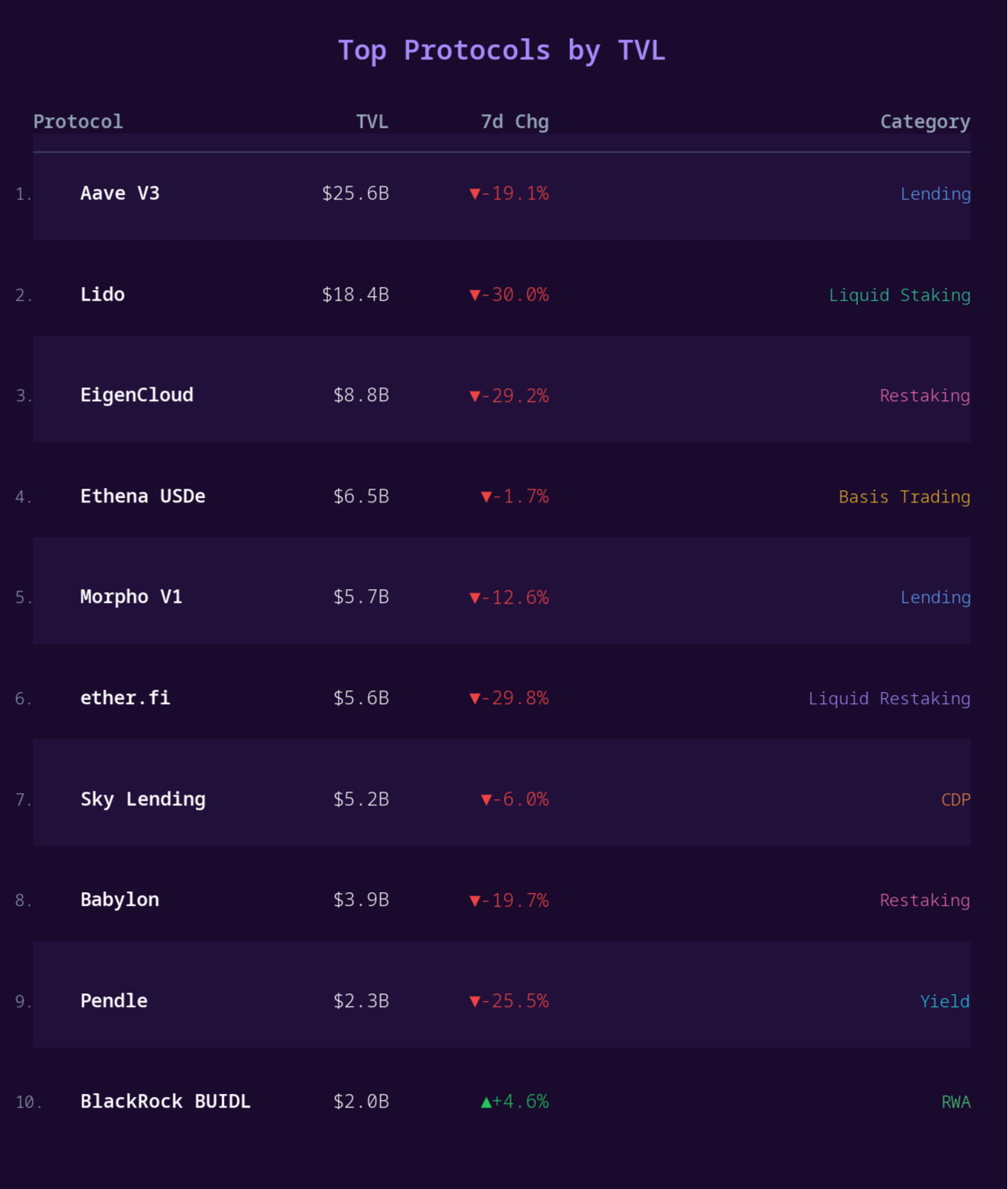
Top DeFi Protocols by TVL
Key Protocol Insights:
- Ethena USDe is the undisputed standout, posting a mere -1.74% weekly decline while the rest of the top 10 shed 12-30%.
- BlackRock BUIDL is the only top-10 protocol in positive territory at +4.61% weekly, reflecting a clear flight to institutional-grade, yield-bearing RWA products.
- Lido, EigenCloud, and etherfi suffered the steepest declines (all approximately -30%), directly reflecting ETH's price collapse. Since these protocols hold predominantly ETH-denominated assets, their TVL mechanically tracks the underlying token price. Notably, the amount of ETH staked through these protocols has actually increased, suggesting no panic unstaking despite the price carnage.
- Morpho V1 demonstrated relative resilience at -12.62%, benefiting from its optimized lending architecture that automatically routes capital to the highest-yielding opportunities.
Chain Performance Analysis
- Hyperliquid L1 is the sole chain with positive weekly momentum at +6.67%, defying the market-wide crash. The HIP-4 prediction market announcement, combined with $225 billion in January trading volume, continues to attract capital even as every other major chain bleeds.
- Arbitrum and Bitcoin DeFi are the hardest hit, both down over 31% monthly. Arbitrum's decline reflects both ETH price exposure and capital rotation away from L2s as gas costs on Ethereum L1 remain low (reducing the value proposition of rollups). Bitcoin DeFi's struggles stem from BTC's 40% drawdown from its all-time high, which has devastated wrapped Bitcoin protocols.
- Tron and Plasma are demonstrating relative stability with single-digit weekly declines (-16.69% and -4.31% respectively). Tron's $84.76 billion stablecoin market cap, the second largest after Ethereum, provides a natural floor for its TVL, as stablecoin-denominated protocols are insulated from token price volatility.
Looking Ahead
Market Outlook
Bitcoin has now fallen nearly 50% from its October 2025 all-time high, breaching $64,000 on February 5, while ETH has shed over 20% in a single week. The "crypto winter" narrative is gaining traction in mainstream financial media, with UBS going so far as to declare that "crypto is not an asset" and Bitcoin ETFs recording $272 million in net outflows on February 3 alone.
However, the contrarian case is building beneath the surface. DeFi's TVL resilience with ETH deployed in protocols actually increasing by 1.6 million during the crash suggesting that productive capital is not leaving the ecosystem.
The $53 million in liquidatable positions within 20% of current prices is a fraction of the $340 million danger zone that existed during the February 2025 correction, indicating the market is far better collateralized. Ethena's near-flat performance (-1.74%) and BlackRock BUIDL's growth (+4.61%) demonstrate that sophisticated capital is rotating into risk-managed strategies rather than exiting entirely.
The macro backdrop remains challenging. The Fed's hawkish stance continues to pressure risk assets, while geopolitical tensions and AI stock selloffs have created correlated drawdowns across technology and crypto markets. Gold's surge above $2,800/oz and Tether Gold's 29% weekly TVL increase confirm the flight to traditional safe havens.
Key Catalysts to Watch
SEC-CFTC "Project Crypto" Implementation
The joint regulatory framework announced January 29 is now entering its implementation phase. The CLARITY Act's progress through committee markup represents the most advanced crypto-specific legislation in U.S. history, and its passage would provide the legal certainty needed for institutional DeFi adoption at scale.
Ethereum's L1 Scaling Pivot
Vitalik Buterin's admission that the "Rollup-centric roadmap" has failed and his call for L1 to return to the core of scaling represents a fundamental strategic shift for the largest DeFi ecosystem.
Institutional DeFi Infrastructure
Ripple Prime's integration of Hyperliquid, Lido V3's institutional stVaults, and BlackRock BUIDL's continued growth all point to an accelerating institutional infrastructure buildout that is largely decoupled from token price action. The RWA tokenization narrative with Provenance chain surging 92% monthly, suggests that the bridge between traditional finance and DeFi is being built regardless of short-term market sentiment.
The Bottom Line
This crash is painful, but it is not 2022. DeFi's structural maturity offers better collateralization, sticky TVL, institutional-grade products, and regulatory clarity, suggesting the sector will emerge from this correction stronger than it entered. The protocols and chains that are gaining capital during the downturn (Ethena, BlackRock BUIDL, Hyperliquid, Provenance) are telling us where the next cycle's alpha will be found: delta-neutral strategies, tokenized real-world assets, high-performance trading infrastructure, and institutional-grade DeFi primitives.
About Portals: Portals is the DeFi Super App. A one-click gateway to the entire on-chain economy. Powered by real-time data and seamless execution, Portals connects traders to over 20 million assets, thousands of protocols, and every major blockchain.
Disclaimer: The content of this newsletter is for informational purposes only. It is not investment advice. Please do your own research and consult with a qualified financial advisor before making any investment decisions. DeFi investments carry significant risks, and past performance does not guarantee future results. More details here.
Portals.fi Blog Newsletter
Join the newsletter to receive the latest updates in your inbox.