Stake DAO on The DeFi Drop: Liquid Lockers, Vote Markets, and the Infrastructure Behind DeFi Governance
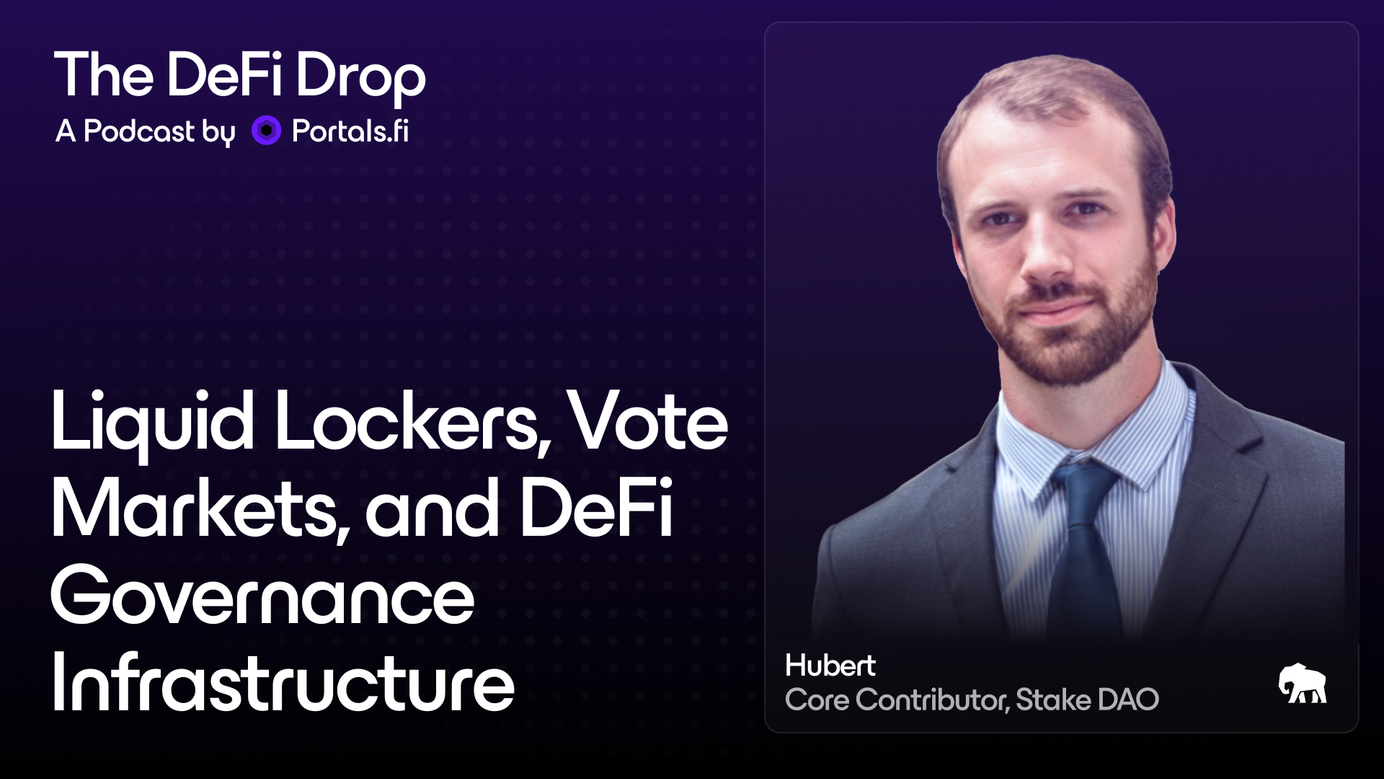
Guest: Hubert, Core Contributor at Stake DAO
Host: Edward Ward, Portals.fi
In this episode of The DeFi Drop, Edward Ward sits down with Hubert, core contributor at Stake DAO, to unpack how one of DeFi’s most important governance infrastructure layers actually works.
Stake DAO has quietly become a major force across the veToken ecosystem. With over $165 million in total value locked and deep integration across protocols like Curve, Balancer, Frax, and Pendle, it operates at the intersection of governance, liquidity, and yield optimization. The conversation explores how liquid lockers work, how Stake DAO scaled its voting power, how OnlyBoost and Staking V2 improved yield mechanics, and why VoteMarket became a dominant marketplace for on-chain incentives.
At a high level, Stake DAO transforms locked governance tokens into productive, composable assets while coordinating liquidity and voting incentives across DeFi. What emerges is a system where yield, governance, and liquidity reinforce each other, creating a durable infrastructure layer rather than a single product.
What Is Stake DAO?
Stake DAO is a DeFi protocol focused on yield optimization and governance infrastructure.
Its core primitive is the liquid locker. Users deposit governance tokens such as CRV and receive liquid representations like sdCRV. These tokens:
- Remain transferable
- Can be used across DeFi
- Earn yield from boosting and governance participation
This model addresses a structural limitation in veToken systems. Locked tokens are typically illiquid and cannot be reused. Stake DAO makes them usable again while preserving their economic value.
“vCRV is not transferable, which introduces the impossibility for the person who locks to exit.”
The Origin of Liquid Lockers and Stake DAO’s Growth
Stake DAO emerged during the early competition around Curve liquidity and veToken mechanics. Early designs such as sdveCRV introduced transferable representations of locked positions, but the model matured as protocols began competing for governance power.
A key insight was that boosting power could be pooled and monetized. By aggregating large amounts of locked tokens, Stake DAO could generate higher yields for users and distribute that value back to participants.
The introduction of vote incentives further accelerated this dynamic. Instead of separating boosting and governance value, Stake DAO structured its system to capture both.
This led to significant growth:
- From 3 million vCRV to over 120 million vCRV
- Over 200 million in effective boosting power including delegated positions
- Expansion across multiple veToken ecosystems
“We managed to go from 3 million vCRV to 120 million vCRV today.”
How Stake DAO Scales Across Multiple Protocols
Stake DAO is designed to be protocol agnostic. The liquid locker model has been extended beyond Curve to multiple ecosystems including Balancer, Frax, Pendle, and others.
Each new locker introduces two challenges:
- Liquidity provisioning
- Governance optimization
Stake DAO addresses liquidity through internal fee mechanisms. Locker users pay fees that are redirected to liquidity providers, reducing reliance on external token incentives.
Governance is managed through a combination of automation and tooling. Proposal monitoring, vote optimization, and reward distribution have been systematized to scale across multiple protocols.
“In one hour you can have votes optimized for 12 lockers and it works very smoothly.”
OnlyBoost and Staking V2: Improving Yield Distribution
One of the most important upgrades in Stake DAO is its staking architecture, often referred to as Staking V2.
Traditional yield aggregators distribute rewards with delays, which creates inefficiencies. Users can enter or exit positions around reward cycles and capture value they did not generate.
Stake DAO redesigned this system to calculate rewards continuously and distribute them instantly based on actual participation.
“We calculate what your funds generate and we give them to you immediately.”
This upgrade also changed how OnlyBoost works. Instead of allocating capital based on projected boost, the system now optimizes for real-time reward rates. Capital is dynamically allocated between Stake DAO and other platforms like Convex to maximize actual yield.
The result is:
- More accurate yield distribution
- Reduced gaming of reward cycles
- Better capital efficiency
VoteMarket and the Evolution of On-Chain Incentives
VoteMarket is Stake DAO’s marketplace for governance incentives, often referred to as bribes.
Protocols use VoteMarket to incentivize voters to direct emissions toward specific liquidity pools. This mechanism allows for transparent and market-driven allocation of rewards.
Hubert frames this system as a coordination mechanism rather than a zero-sum game.
“It’s more of a co-incentive framework.”
Instead of relying on informal relationships or opaque agreements, VoteMarket enables:
- On-chain incentive distribution
- Transparent pricing of governance power
- Efficient liquidity coordination
Stake DAO has also integrated VoteMarket deeply with its liquid lockers. This creates a feedback loop:
- More locked tokens increase voting power
- More voting power attracts incentives
- More incentives increase yield
Product Synergy as Stake DAO’s Core Advantage
Stake DAO’s competitive advantage is not a single feature but the interaction between its products:
- Liquid lockers accumulate governance power
- Yield strategies maximize returns on that power
- VoteMarket monetizes governance demand
These components reinforce each other. Governance power drives incentives, incentives drive yield, and yield attracts more liquidity.
“What makes it very difficult to replicate is that they work together.”
This creates strong network effects. Replicating Stake DAO would require not just building similar tools, but also accumulating comparable governance power and liquidity.
Expanding Beyond Curve: Lending and New Growth Vectors
As Stake DAO approaches capacity within Curve, it is expanding into new areas such as lending through curated vaults.
These vaults allow users to:
- Borrow against yield-generating positions
- Loop strategies for higher capital efficiency
- Access scalable markets beyond Curve liquidity constraints
This expansion is designed to reduce dependence on a single ecosystem and unlock new growth.
“We want to be able to approach people and say yes, regardless of size.”
Sustainability and Market Cycles
Stake DAO’s revenue model reflects broader market conditions. Yield products are sensitive to token prices, while governance incentives provide additional income streams.
VoteMarket has historically contributed a large share of protocol revenue, especially during bear markets.
“The core of our business is the yield.”
The protocol’s strategy is to diversify across products while maintaining a strong focus on yield generation.
DeFi TVL Outlook
At the end of the episode, Hubert gives a forward-looking view on DeFi growth.
With total value locked around $98 billion at the time of recording, his prediction for June 21, 2026 is:
“117.”
Key Takeaways
- Stake DAO’s liquid lockers make governance tokens liquid and composable
- Governance power is aggregated and monetized through boosting and vote incentives
- Staking V2 enables real-time yield distribution and better capital efficiency
- VoteMarket creates a transparent marketplace for on-chain incentives
- Product synergy across lockers, yield strategies, and incentives drives network effects
- Expansion into lending and curated vaults supports long-term growth
About Stake DAO
Stake DAO is a DeFi protocol focused on liquid lockers, yield optimization, and governance infrastructure. It enables users to lock governance tokens such as CRV and receive transferrable representation that remain usable across DeFi. Through products like sdTokens, OnlyBoost, and VoteMarket, Stake DAO aggregates voting power, optimizes yield strategies, and facilitates on-chain incentive coordination across multiple ecosystems, including Curve, Balancer, Frax, and Pendle.
About Portals.fi
Portals.fi is the DeFi Super App, a one-click gateway to the entire on-chain economy. Powered by real-time data and seamless execution, Portals.fi connects users to millions of tokens, thousands of protocols, and every major blockchain through a unified interface.
Portals.fi Blog Newsletter
Join the newsletter to receive the latest updates in your inbox.