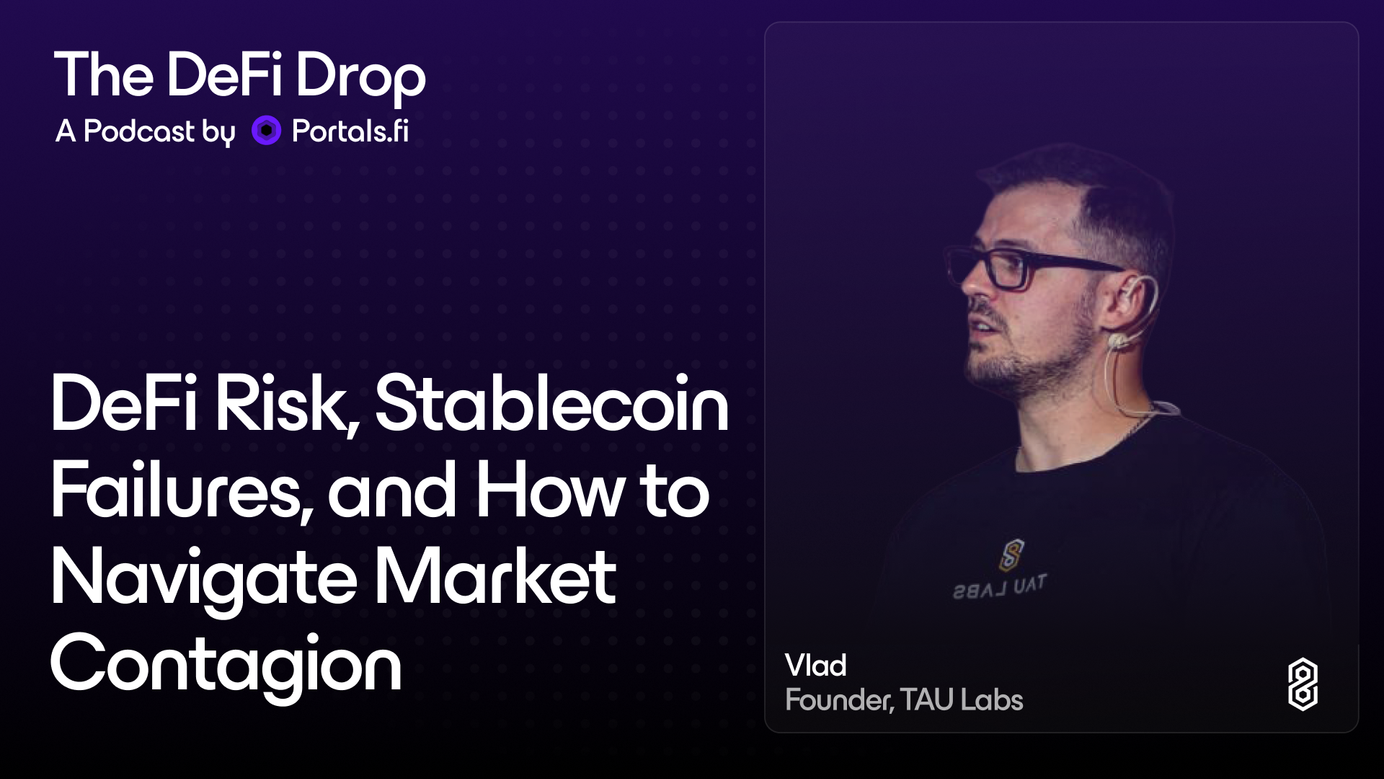
Tau Labs on The DeFi Drop: DeFi Risk, Stablecoin Failures, and How to Navigate Market Contagion
Guest: Vlad, Tau Labs
Host: Edward Ward, Portals.fi
In this episode of The DeFi Drop, Edward Ward is joined by Vlad from Tau Labs for a current affairs special following a turbulent weekend in DeFi.
A major stablecoin failure triggered sharp market reactions, with an exploit allowing tens of millions in unbacked tokens to be minted and dumped within minutes. The event led to a rapid depeg, cascading withdrawals across lending markets, and renewed scrutiny on risk management practices across the ecosystem.
This conversation steps away from product deep dives and focuses on what actually happens during these moments. It covers how failures propagate through DeFi, why the same structural risks continue to appear, and what both users and protocols should be doing when markets turn unstable.
Tau Labs provides a useful lens for this discussion. With a strong track record across vault strategies and risk-aware allocation, the team has consistently avoided major incidents while operating in volatile conditions. The episode explores how they approach risk, how they navigate market stress, and what this latest event reveals about the current state of DeFi.
What Happened: The Stablecoin Depeg and Immediate Impact
The trigger for this episode was a critical exploit in a stablecoin system. An attacker was able to mint a large amount of unbacked tokens with minimal capital, causing the asset to collapse from its peg within minutes.
The direct consequences were immediate:
- Lending markets holding the asset as collateral saw rapid withdrawals
- Demand for borrowing against the asset disappeared
- Utilization rates spiked across affected markets
- Borrow rates increased sharply as liquidity exited
From a systems perspective, this is a supply and demand shock. When collateral becomes unreliable, lenders pull capital. This reduces available liquidity and pushes utilization toward extremes.
This mechanism explains why seemingly isolated failures can impact multiple protocols at once.
“Whenever a lot of capital is moved out of a market fast, this causes utilization to spike.”
Contagion in Lending Markets
The most important dynamic discussed in the episode is contagion.
When a stablecoin or major collateral asset fails:
- Lending markets react by reducing exposure
- Large allocators reshuffle capital across protocols
- Borrow rates spike to rebalance supply and demand
- Leveraged positions unwind
This creates a feedback loop. High utilization increases borrowing costs, which forces additional exits, which further reduces liquidity.
The severity depends on how concentrated exposure is. In previous cases, heavily leveraged positions amplified the impact and spread it across multiple markets. In this instance, the effects appear more contained but still significant.
“I don’t think this is as bad as previous events, but it’s still early.”
Are DeFi Systems Improving or Repeating the Same Risks
One of the central questions is whether DeFi is getting better at handling these failures.
The answer from Tau Labs is direct. The core issue is not purely technical. It is structural and incentive-driven.
Protocols and curators are often evaluated based on two metrics:
- Total value locked
- Yield
These metrics attract capital, but they also create pressure to prioritize growth over risk management.
“The only way to get large funds to talk to you is to have large TVL or large APY.”
This leads to a recurring cycle:
- A protocol offers high yield or rapid growth
- Capital flows in without deep risk analysis
- A failure occurs
- The market reacts and calls for better standards
- Behavior resets and the cycle repeats
From this perspective, the problem is not a lack of awareness. It is misaligned incentives.
What This Means for Users
For users, the key takeaway is that risk is always present. No strategy, vault, or protocol is risk-free.
The episode highlights several practical steps:
1. Diversification matters
Allocating across multiple strategies reduces the impact of a single failure.
2. Balance risk profiles
Combining higher-yield strategies with more stable, lower-yield positions improves resilience.
3. Understand the curator
Not all vaults are managed the same way. Some rely on manual allocation, while others use automated systems with continuous monitoring.
4. Evaluate transparency
Assets used as collateral should be verifiable. Black-box structures introduce additional uncertainty.
“It’s not good to have all your eggs in one basket.”
How Tau Labs Approaches Risk
Tau Labs differentiates itself through infrastructure and process.
Many curators operate as allocators. They manually move funds across protocols using wallets or multisigs. Tau Labs takes a different approach:
- Automated strategy execution through internal systems
- Continuous monitoring via custom dashboards and alerts
- Real-time response to market changes
- Ongoing updates to strategy logic as conditions evolve
This allows them to act quickly during volatile periods and adjust allocations before risks escalate.
“We have actual automation that runs in our own data pipelines.”
This infrastructure also enables faster deployment of new strategies and more consistent performance across market cycles.
Risk Is Not Zero and Never Will Be
A recurring theme in the conversation is the misconception that risk can be eliminated.
Even the safest strategies carry some level of exposure, whether from smart contracts, market conditions, or protocol design.
“A lot of people misunderstand risk and think it should be zero.”
In DeFi, this is even more pronounced because innovation cycles are fast and new mechanisms are constantly introduced. Some designs prioritize speed or novelty over robustness, which increases the likelihood of edge cases and failures.
At the same time, these events serve a purpose. They reveal which protocols and teams can operate reliably under stress.
“What matters is how you respond.”
What Good Operational Security Looks Like
For protocols and teams, the episode outlines a few principles:
- Ensure full transparency of collateral and backing assets
- Avoid reliance on opaque or unverifiable systems
- Build monitoring systems that can react in real time
- Prioritize user access to liquidity and withdrawals
- Maintain clear communication during incidents
For users, the focus remains on understanding exposure and selecting strategies aligned with their risk tolerance.
The Human Layer of Risk
Beyond technical systems, one of the strongest signals of reliability is the team behind a protocol.
Quantitative analysis can only go so far. Execution, decision-making, and communication during stress events depend on people.
“The rest of the decision really comes down to the team.”
Reputation is built over time and tested during moments like these. Protocols that handle failures responsibly often emerge stronger, while others struggle to recover.
Closing Thoughts
This episode reflects a broader truth about DeFi. The technology continues to evolve, but the underlying dynamics of risk, incentives, and behavior remain consistent.
Failures are part of the system. What matters is how capital is allocated, how risks are understood, and how quickly systems and teams can respond when conditions change.
For users, the goal is not to avoid risk entirely. It is to manage it deliberately.
For protocols, the challenge is to align incentives with long-term resilience rather than short-term growth.
About Tau Labs
Tau Labs is a DeFi risk management and vault strategy firm focused on building automated, data-driven allocation systems across on-chain markets. By combining quantitative models, real-time monitoring infrastructure, and active risk management, Tau Labs aims to deliver consistent yield while navigating volatility and minimizing exposure to structural weaknesses in DeFi protocols.
About Portals.fi
Portals.fi is the DeFi Super App, a one-click gateway to the entire on-chain economy. Powered by real-time data and seamless execution, Portals.fi connects users to millions of tokens, thousands of protocols, and every major blockchain through a unified interface.
Portals.fi Blog Newsletter
Join the newsletter to receive the latest updates in your inbox.