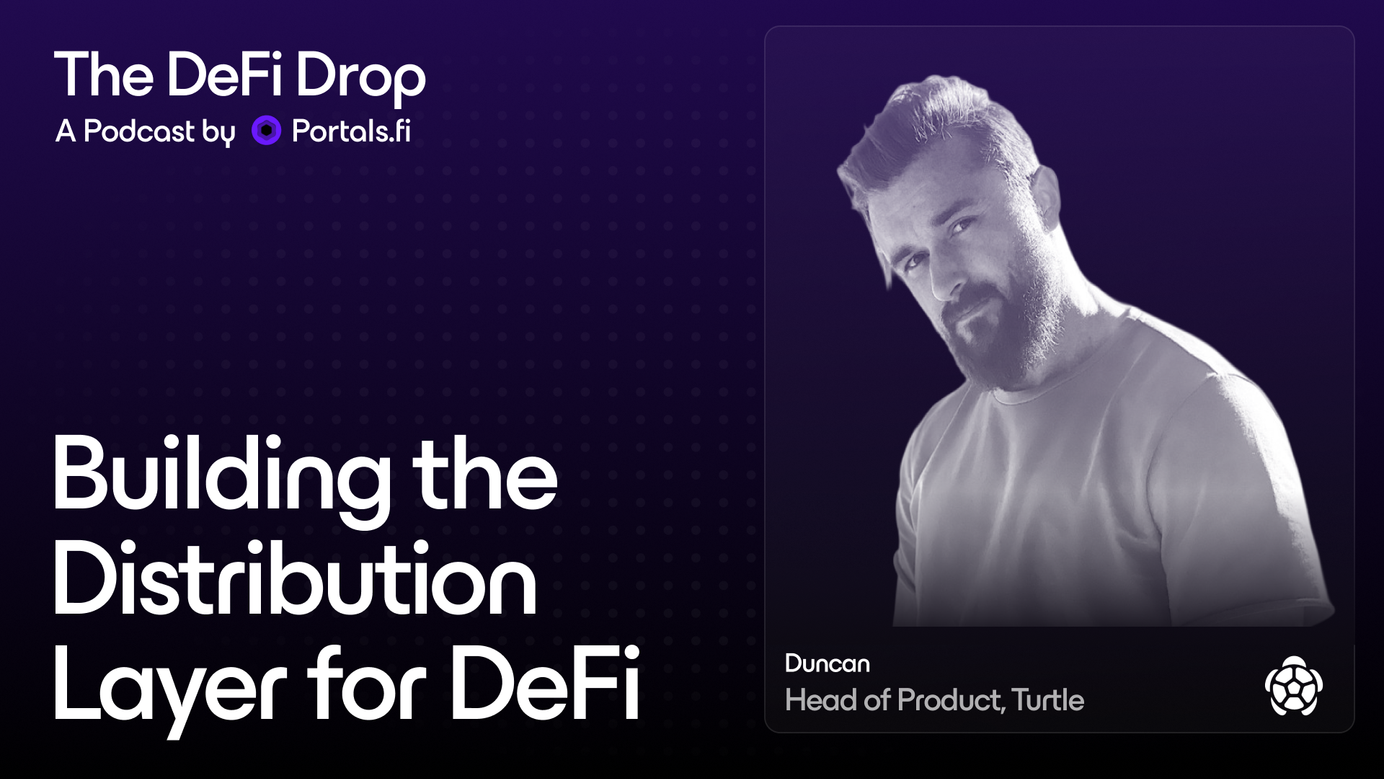
Turtle on The DeFi Drop
Guest: Duncan, Head of Product at Turtle
Host: Edward Ward, Portals.fi
In this episode of The DeFi Drop, Edward welcomed Duncan, Head of Product at Turtle, to explore how the protocol is creating one of the most important liquidity coordination layers in DeFi. Over the past 18 months, Turtle has routed more than US$ 5.6 billion in lifetime TVL and attracted 400,000+ wallets across boosted point deals, vault campaigns, and liquidity programs.
“We curate liquidity for them. We advise them on incentive design, structure their campaigns, and help them attract the right amount of liquidity at sustainable rates.” — Duncan, Turtle
What Is a Distribution Protocol?
Turtle describes itself not as a yield aggregator or vault system, but as Web3’s first true distribution protocol. The protocol allows DeFi projects to launch structured, on-chain campaigns that attract capital from LPs in an open, transparent way. Historically, these kinds of enhanced reward opportunities were only available through private negotiations with large liquidity providers. Turtle makes them public, programmable, and accessible.
The result is a democratized liquidity layer where anyone can access curated campaigns with above-market reward potential, while protocols gain a scalable path to deploy incentives across a global LP base.
From Boosted Points to Institutional-Grade Campaigns
Turtle began with points-boost campaigns, offering enhanced rewards like the well-known 25 percent EtherFi boost. These early agreements were informal, tracked via APIs rather than contracts, yet generated over US$ 7 million in revenue and attracted deep protocol partnerships.
“As long as our partners satisfied the deal, we agreed not to sell their tokens or create sell-pressure,” Duncan explained. “It built trust.”
That trust evolved into a structured offering. Turtle launched audited vault infrastructure through partners like Veda, Lagoon and Concrete, enabling more complex campaigns with minimal smart-contract risk.
Self-Custody and Smart-Contract-Light Design
A core design principle at Turtle is self-custody. Users never give up control of their assets. Even early on, campaigns were structured without smart contracts, relying instead on off-chain tracking and honor-based fulfillment. As the protocol scaled, Turtle added modular vaults without compromising on that principle.
“We never wanted to compound smart-contract risk for users. All deposits remain in the user’s control. That’s core to how Turtle works.”
Turtle’s focus is on yield access and incentive efficiency, not active fund management.
Vault Ecosystems and Full-Scale Liquidity Programs
After proving its boosted-deal model, Turtle expanded into vault-based campaigns. A key milestone was the partnership with TAC, where Turtle structured a full ecosystem incentive program across lending, trading and asset onboarding.
This vault system now sits at the core of Turtle’s growth strategy. Protocols use it to design and distribute multi-layered rewards, while LPs benefit from clear risk parameters, performance tracking and composable deal structures.
400K+ Wallets and Distribution at Scale
Turtle’s traction has been powered by a massive and diverse user base. Over 400,000 wallets have interacted with the platform, with approximately 30 percent of wallets accounting for 90 percent of deployed capital.
Turtle’s leaderboard system, inspired by Cookie and Kaido, blends social activity with liquidity provisioning. The result is an organic mix of campaign-driven users and long-term LPs, each rewarded based on transparent metrics.
“Turtle’s role is to channel liquidity efficiently,” Duncan said. “Some users are here for campaigns, others are long-term LPs.”
The Turtle Earn Widget: Liquidity as a Service
A major product innovation is the Turtle Earn widget, which lets other apps integrate Turtle’s deal flow and earn revenue for routing liquidity. This creates a distribution layer similar to an ad network but for DeFi yield. Over time, Turtle expects more inflows to originate from integrated partners than from its own frontend.
The Earn SDK further expands this vision, letting wallets, dashboards and aggregators route users into campaigns with zero custody and full transparency.
Governance, Staking and the Institutional Frontier
Turtle’s TGE introduced staking, delegation and early-stage governance. Stakers gain leaderboard boosts and will eventually vote on reward allocation and product development. The protocol is also investing in institutional-grade features such as:
- Due diligence workflows
- Transparent on-chain reward tracking
- Real-time LP and protocol analytics
- Partner dashboards with advanced visibility
Turtle aims to become the infrastructure through which DeFi liquidity flows at global scale.
DeFi TVL Prediction Game
Every episode of The DeFi Drop ends with a prediction. With DeFi TVL sitting at US$ 123B, Duncan offered a cautiously optimistic estimate:
“Let’s call it 135 billion,” he said. “Institutional inflows, stablecoin infrastructure and genuine innovation are what will move the needle in the next phase of DeFi.”
About Turtle: Turtle is a distribution protocol for Web3 that connects protocols with liquidity providers through curated, on-chain campaigns. With support for vaults, points deals, and programmatic incentives, Turtle transforms liquidity coordination into a transparent and scalable layer for DeFi. Its architecture prioritizes user custody, efficient deal flow and institutional integration, all without compromising on security or composability.
About Portals.fi: Portals.fi is the DeFi Super App. A one-click gateway to the entire on-chain economy. Powered by real-time data and seamless execution, Portals.fi connects traders to over 20 million assets, thousands of protocols, and every major blockchain.
Portals.fi Blog Newsletter
Join the newsletter to receive the latest updates in your inbox.